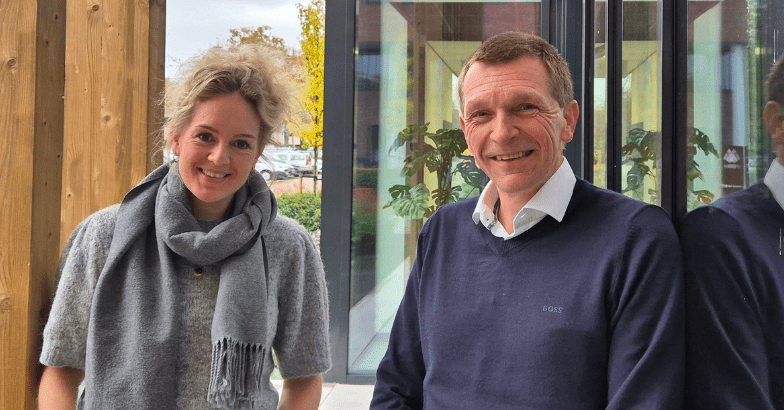
In this double interview, Elsbeth and Paul offer insight into the process and share their personal experiences with reintegration. It also becomes clear what second track process experiences look like in practice.
Is the person reintegrating an employee, candidate, participant, or coachee?
Elsbeth begins: “In a reintegration process you are often called a ‘candidate’, but that made me feel even more different, as if I no longer belonged. If you just use ‘employee’, it feels like I’m still part of the team.” Paul agrees: “In my reports, I always call people ‘employee’ or ‘member of staff’. That sounds more inclusive and helps the participant continue to feel connected.”
From warning signs to hopelessness
Elsbeth was working as an HR officer and noticed she was losing control. “I had a lot of warning signs, like being short-tempered, having lots of sick days, and I also slept poorly, but no one dared to mention them—not even me. Eventually, the occupational health advisor called me for something else. But she immediately sensed that things weren’t going well for me. This led to my first period of illness and a long reintegration process. My advice: Admit when you can’t go any further. I just kept going. I thought, if everyone else can keep so many balls in the air, then so should I. But sometimes you have to accept that it’s just not possible for a while.”
Paul adds: “I see this often in my reintegration processes. People keep going. They use vacation days to recover and cover up the fact they need time to rest. The fear of failure and the feeling that you always have to keep going is something many employees recognize.”
Grief and acceptance
Elsbeth shares that she felt ashamed to be at home and guilty: When your environment regularly asks: ‘Are you still at home?’ that doesn’t help. Elsbeth: “I regularly asked myself: When will that moment come when I feel better? Because I was working hard on my recovery. The turning point only came when I realized that I had to accept what had happened to me. I acknowledged that I could no longer function as I used to, and only then did I feel a sense of peace. From that moment, I could make a different move and head in a new direction. The eureka moment doesn’t just appear, as is often said after a burnout. You have to find and create it yourself.”
Paul often sees this too: “The grieving process of saying goodbye to an old work situation is tough, but it’s part of it. When people realize they can’t go back to their old position and need a second track process, it often feels like a weight has been lifted. In this phase, you also clearly see what second track process experiences do to someone.”
The power of an external coach
Elsbeth sought contact with an external coach: “That felt very safe to me. She asked questions I hadn’t dared to answer before, like: ‘Do you actually want to return to your old employer?’ This honesty was an eye-opener for me, and I gradually got used to the idea of cutting the cord. I dared to take the step to leave, and that gave me an enormous sense of freedom.”
Paul: “My experience is also that an external party can be more objective, without the interests of the employer. Creating a safe environment for the employee is so important—it’s the foundation. What we discuss stays confidential; I don’t run to HR with it. It’s all about trust and the pace of the participant. I guide where needed, but ultimately the goal is to get someone moving again, no matter how small the step is.”
The first steps in a new direction
After her first period of reintegration, Elsbeth relapsed. Elsbeth: “Relapsing wasn’t easy, but it did tell me something important. It wasn’t a failure, not starting over. It was simply a sign that my recovery wasn’t complete yet. That my strength still needed to deepen to withstand storms. I chose to follow a Work-fit program via the UWV. That’s where I discovered where my strengths and interests lay. I started to explore and found out that coaching really suited me. That gave me back my confidence. In a phone call with Paul from MEPD, I mentioned that I was reintegrating and looking for a workplace. I hadn’t thought far ahead about what that process would look like. I kept it small for myself: I get in the car. Drink a cup of coffee first. Get to work. Etc. Keeping it small and not thinking too far ahead really helped me.”
Paul explains that he also always works with small steps. “We don’t look too far ahead, so the threshold stays low. That creates security and trust. Sometimes participants wonder if they can handle a position or what their salary will be, but I encourage them to just start by sending in the application. After that, we’ll see what the next step is.
The role of employer and colleagues
Both Elsbeth and Paul highlight how important the role of the employer and colleagues is. “Really ask how someone is doing, or even better: How are you today?,” says Elsbeth. This simple question can make the difference between burnout and staying afloat. Stay transparent with each other, name what’s going on in your life, and make sure there’s a safe environment.”
Paul adds: “I also see in the processes I support that employees really
value the support from HR and colleagues. It gives them the feeling that they still belong.”
Tips for employers and employees
Elsbeth advises employers to recognize that reintegration is much more than building up working hours. “I didn’t just ‘return from a vacation’; I am changed, both at home and at work. That needs to be acknowledged.”
Paul emphasizes to employees that that first step is essential: “Be brave, call the employer, ask for that chance. Everything starts with the first step.”
Want to learn more about reintegration?
Or do you have questions about this article? Feel free to contact Elsbeth or Paul.