


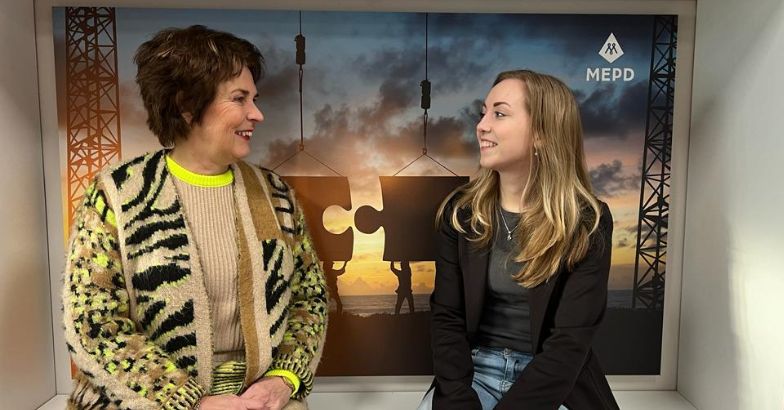
A two-part feature with our young intern Julie van den Boom and our senior team manager MEPD South, Tanja Janssen. Both respond to statements on topics like personal development, work pressure, and the role of the manager, each from their own generational perspective, experience, and viewpoint. Curious about the differences and similarities? Read along!
Do people make the organization?
Julie: Yes, I agree with this statement, because I believe that people play a crucial role in the functioning of an organization. Knowledge and collaboration between people are very important in this. I value a people-oriented approach and find this more important than a task-oriented approach. At MEPD, I like that there is a focus on the individual within an organization. Attention is paid to people’s needs and how they are doing. I find this important because individuals can function optimally when they are comfortable with their place and how they feel. In addition, MEPD puts effort into fostering mutual engagement, where everyone shows interest and is willing to help each other. This aspect is very important to me in feeling at home within an organization.
Tanja: I fully agree as well: the people are the organization. To add to Julie; within MEPD, our coaches are central. When they develop, feel comfortable and safe, they can mean even more for candidates or clients. For myself, I feel at home when I am seen. That I can be who I am.
Importance of personal development and the employer’s responsibility?
Tanja: Development is a lifelong process. Times are changing fast and you have to keep up. But that also keeps you young. Life is interesting and offers you a lot. It’s not always a course that gives you the tools, life itself teaches you a lot if you are open to it. Life is not a dress rehearsal; you have to do it for real straight away. In fact, that’s the greatest school—that’s what I try to pass on to the younger generation too. As an employer, you have the responsibility to offer your employees relevant training and workshops to keep their skills and knowledge up to date. There should also be the opportunity for peer reviews together.
Julie: I find personal development very important and I like to continuously improve myself and become a better version of myself. My growth comes, among other things, from learning from mistakes, receiving feedback from others (both at work and privately), and through self-reflection. I believe that an employer is partly responsible for the development of their employees. In my view, it’s the employer’s task to gauge whether an employee is open to development. This doesn’t have to happen often—once in a conversation, for example. During that, it can be discussed whether the employee is interested in developing. Additionally, I think it’s the employee’s responsibility to indicate if they want to grow and are willing to go along with changes.
What does your ideal manager look like? What qualities do they possess?
Julie: I value open communication with my manager, where I can discuss everything. It’s important to me that he or she listens and takes me (and my concerns) seriously. I also like it when the contact is approachable and I can easily start a conversation. As an intern, I would like to have weekly contact with my supervisor. This doesn’t have to take long, but then I can talk about how I’m doing or how the internship is going, discuss any challenges, and ask questions. If I am employed by a company, at the start of my career, I’d like to have a conversation once a month or every other month. During these meetings, I can share my experiences, discuss any obstacles, and ask relevant questions at that moment.
Tanja: An ideal manager has soft skills and respect. In addition, clarity and honesty are very important to me. You should be able to brainstorm together with your manager, work together to achieve your collective goal. Both of you are responsible, but the manager makes the final decision, always in consultation or with clear reasoning. In my role as a manager, I want my employee to be able to be themselves and have an open relationship with me. Regularly sitting down together, looking together for solutions to issues. Daring to name what isn’t going well and ensuring there’s a solution. This has to come from both sides. It cannot be one-way traffic. I also dare to be vulnerable and hope this allows my colleague to be themselves. You can’t really keep your private life separate from your work. It’s part of who you are, so it should be welcome at work too. Regularly, we get together as a team, and everyone can contribute. I also find it important—and even a must—that team members work out ideas among themselves, without me, and brainstorm about the business, or dare to ask each other for help/insight. I am a part of the team, and I don’t need to know or be able to do everything.
How do you handle work pressure? How can an employer help with the work-life balance?
Tanja: Work pressure is nowadays a buzzword. You experience work pressure yourself. What is it really? Often, you impose it on yourself or create it in your mind. Sometimes life is balanced, sometimes it’s hectic. You have to decide for yourself how you deal with it. As an employer, you can only think along and facilitate when the employee indicates that the workload is too much. So, if you’re struggling, ask for help. Be honest with yourself and your manager. Where does the pressure really come from? You set your own expectations. Dare to tell your manager if you feel out of balance. We are not robots, so you can’t always be under tension. And that’s fine. Humanity, loving yourself, and being realistic get you far. If you continue to feel work pressure despite help, it may mean the job no longer suits you. Then you look for another job. Not really a problem, right?
Julie: I make sure to relax both during and outside work. It’s important to me to respect my breaks and set aside time for myself or to talk/think about non-work-related topics. In my free time, I also consciously create moments of rest. In addition, I exercise 2 or 3 times a week to clear my head and boost my energy. I try to regularly do activities that give me energy or make me happy. An employer or manager could help by checking in every two months to ask how I’m doing and how I’m experiencing work pressure. This gives me a chance to indicate if I’m struggling, since I’m less likely to bring this up myself. It’s also important that an employer listens carefully to what I and my colleagues are saying, for example about the number of appointments we have, or whether we work evenings and on our days off.
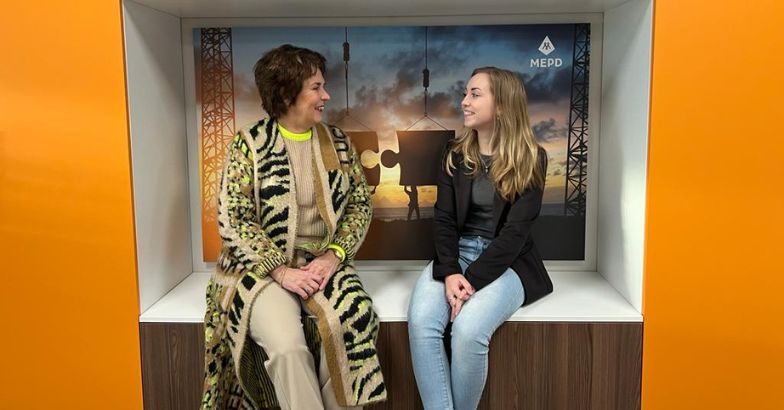
What does your ideal job look like? And what do you enjoy about working with another generation?
Julie: In my ideal job, I want to help people with their questions, preferably through coaching. I like working on location, but it’s fine to work from home one day a week for administration or preparations. My ideal working hours start at 9 and end around 5:30, without the need to work extra in the evenings. I think it’s valuable to work with an older generation because they have gained a lot of knowledge and life experience over the years. On the other hand, younger generations have the latest knowledge from their recent education. Together, these generations can bring valuable added value to a company. They can complement each other and provide critical perspectives on each other’s approaches.
Tanja: I have my ideal job. Freedom, great colleagues, occasionally working from home, sometimes needing to push a bit. Always new developments at MEPD, in business life, for our clients. What more could you want? The younger generation keeps you sharp, sometimes sees things differently, and that’s great. No one has a monopoly on the truth. And, “we did it this way in the past,” or “we’ve always done it like this”—those don’t exist in my world. I live and work now together with young and older colleagues, clients, and my (grand)children. Of course, I have life experience, but you can sometimes borrow it if you want, but it’s mine and I use it when it suits me/us. Everyone should have the chance to gain their own life experience. And that’s always good.


